Diffusion Over Networks
Epidemiology for Economists

In the early 20th century, a number of advances were made in the mathematical modeling of epidemics. These well-known compartmental models, such as the Susceptible-Infected-Recovered (SIR) model, gained wide international interest during the 2020 pandemic - introducing an entire population from other fields to the importance of R0, exponential spread, and networks of transmission.
In the 21st century, there has been renewed interest in a different type of mathematical spread: the spread of innovations and economic diffusion. However, what has percolated less rapidly is how these insights from epidemiology provide a useful mental model for understanding how innovations diffuse within society.
What I’ll provide in this post is a small informal bridge between the two fields.
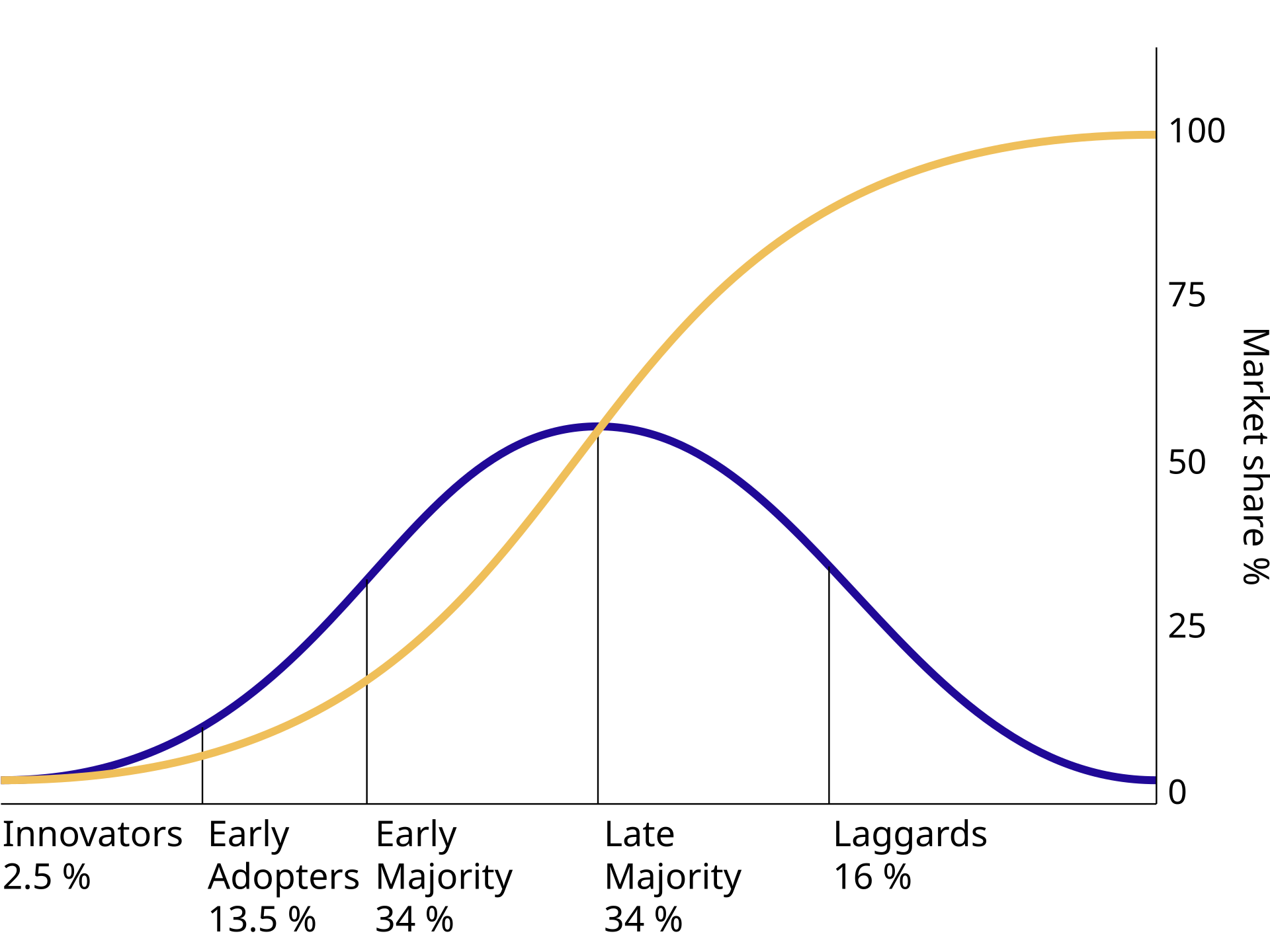
Firstly, a quick review. In 1962, Everett Rogers published Diffusion of Innovations. In it he provides an account of the famous adoption curve in which individuals are divided into innovators, early adopters, the early majority, the late majority, and the laggards - following an S-curve of adoption. The decision to adopt a new innovation is driven by a number of factors, including relative advantage, social structure, communication channels, and characteristics of the innovation itself, such as whether it is an embodied product. But let us ignore that for now and instead say only that the social network will be important and that certain factors can influence the rate of spread.
Let us see if we can generate the S-curve based on a simple model.
This model consists of individuals connected to each other through a network. A network consists of nodes and connections between these nodes. Individuals who have adopted the innovation are infected and are shown in green. Those who have not adopted the innovation are susceptible and shown in red. We begin with one green infected node (the originator of the innovation). At every time step, individuals that are connected to an infected individual with some probability will become infected themselves (adopting the innovation). Let’s see how this plays out with some data:
What we see is that the innovation initially spreads slowly, only affecting a few individuals. As the innovation becomes more widespread the rate of the adoption speeds up, becoming exponential. As the majority are infected, the diffusion slows down until it eventually reaches the remaining laggards. Individuals that are not connected to the network (such as the red dot in the top left) are never affected.
I’m a fan of the epidemiology analogy, because it helps explain many things that may appear puzzling when looking at the diffusion of innovations. Firstly, it helps to explain why the diffusion of technology can be much slower than we may expect - even when the innovation confers obvious advantages over the status quo: the spread of electricity, the telephone, the washing machine, and so on, took place over decades in the United States - in some cases, only reaching commonplace adoption nearly a century after their development.
Secondly, the analogy with diseases contains within it the idea of Recovery (the R in the SIR model). For innovations this may be better thought of as forgetting. Forgetting of innovations happens far more often than we may suspect. In the opening chapter of the Diffusion of Innovations, Rogers provides the memorable example of the discovery of lemon juice in warding off scurvy, found by Captain James Lancaster through a controlled experiment in 1601. Far from being adopted immediately, this insight fell into obscurity, only being rediscovered around 150 years later by Dr. James Lind in 1747, and only being deployed at wide scale by the British Navy by 1795. Forgetting is an intrinsic characteristic in the diffusion of innovations.
Finally, there is the useful idea of R0 and Re - the reproductive numbers, or the number of new infections that one infection is likely to generate. As many will remember from the pandemic, R0 helps to determine whether an epidemic is likely to become widespread, with a R0 > 1 producing exponential spread and R0 < 1 leading to a limited transmission. Both the intrinsic characteristics of the disease and the network structure influence the effective reproductive number. This was a key rationale for control measures such as social distancing, which reduce the interconnection of nodes and so slow the rate of spread.
Similarly, the characteristics of an innovation will have a direct impact on the likelihood that it will spread quickly. These include the apparent advantage of the innovation (such as ease of use, effectiveness, or cost), whether the innovation is an embodied product or is a method of practice, whether there are any barriers to entry (e.g. technical skill requirements), and so on. In addition, network structure will affect the rate of diffusion, with centrally connected nodes playing a disproportionate role in transmitting an innovation to the broader society - in effect, acting as superspreaders for an innovation. This helps to illustrate the critical (and often under-looked) role that translational research institutes and large central institutions play in innovation diffusion. Further, the slowdown in diffusion of innovation that can occur when these networks are disrupted or disconnected.
My goal with this post has been to provide a brief, non-technical introduction to an analogy between economic and epidemiological diffusion that I find fascinating (see: this post from the start of the pandemic looking at policy transmission). For those who are interested in going deeper I recommend these as a starting point:
Everett Rogers (1962), The Diffusion of Innovations. The canonical diffusion of innovation text, continuing to be updated until Rogers death in 2003. One of the clearest and complete descriptions on factors that influence the adoption of technologies, along with the development of diffusion research in multiple fields.
Abhijit Banerjee, Arun G. Chandrasekhar, Esther Duflo, Matthew O. Jackson (2013), The Diffusion of Microfinance. An application of network diffusion in development economics, which connects back to the epidemiology literature.
István Kiss, Joel C. Miller, Péter L. Simon (2017), Mathematics of Epidemics on Networks: From Exact to Approximate Models. An excellent textbook on epidemic spread focusing on how network characteristics affect diffusion.